Songs from the Coalfields
What the miners brought with them
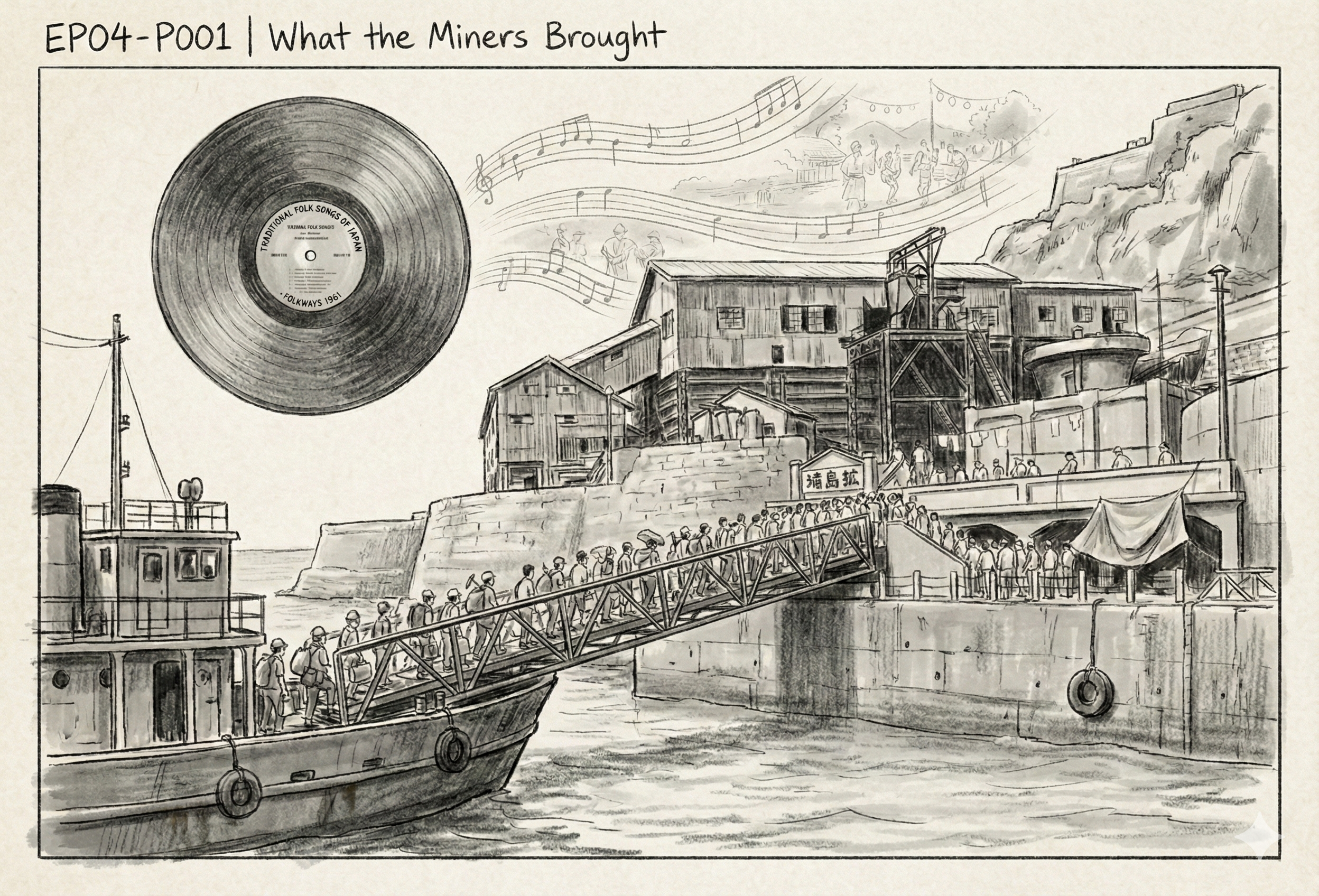 Storyboard panel from Episode 04 — charcoal on textured paper
Overview
- Hashima's population in the 1950s–60s was drawn from coalfield regions across Japan
- Workers arrived with regional dialects, cultural traditions, and folk songs from home
- The 1961 Folkways album Traditional Folk Songs of Japan documents the source cultures from which Hashima's community was assembled
- The absence of documented folk songs from Hashima itself raises questions about what happens to tradition in artificial, company-controlled communities
- Sound offers evidence of community life that official records rarely capture
Learning Outcomes
- Analyse folk songs as historical evidence of labour, migration, and community
- Understand how recording technology transforms oral traditions into commodified heritage
- Recognise intangible cultural heritage as a counter-archive to official records
- Interpret the absence of documentation as itself a form of historical evidence
- Practice listening as a methodology for historical inquiry
🎧 An Audio Experience
This module invites you to listen as a form of historical inquiry. The songs you will hear represent the regional traditions that Hashima's workers carried in memory — the soundscapes of the places they left behind.
For the best experience, use headphones. These recordings date from 1961 and have the warmth and texture of analogue tape.
When miners and their families arrived on Hashima Island from the mid-1950s onward, they came for the higher wages Mitsubishi paid for working in such an isolated, dangerous place. They came from Fukuoka and Fukushima, from Kagoshima and Tottori, from coalfields that were declining and villages that were emptying. They came to a company town where the flow of goods was controlled by the company store, the open-air market, and the single daily boat from Nagasaki — when weather allowed.
They also came with something that couldn't be controlled: the songs, dialects, and cultural traditions of their home regions.
Japan's Coalfield Geography
The four songs in this module represent regions from across Japan — places from which Hashima's workers migrated. Click the markers to explore each source region.
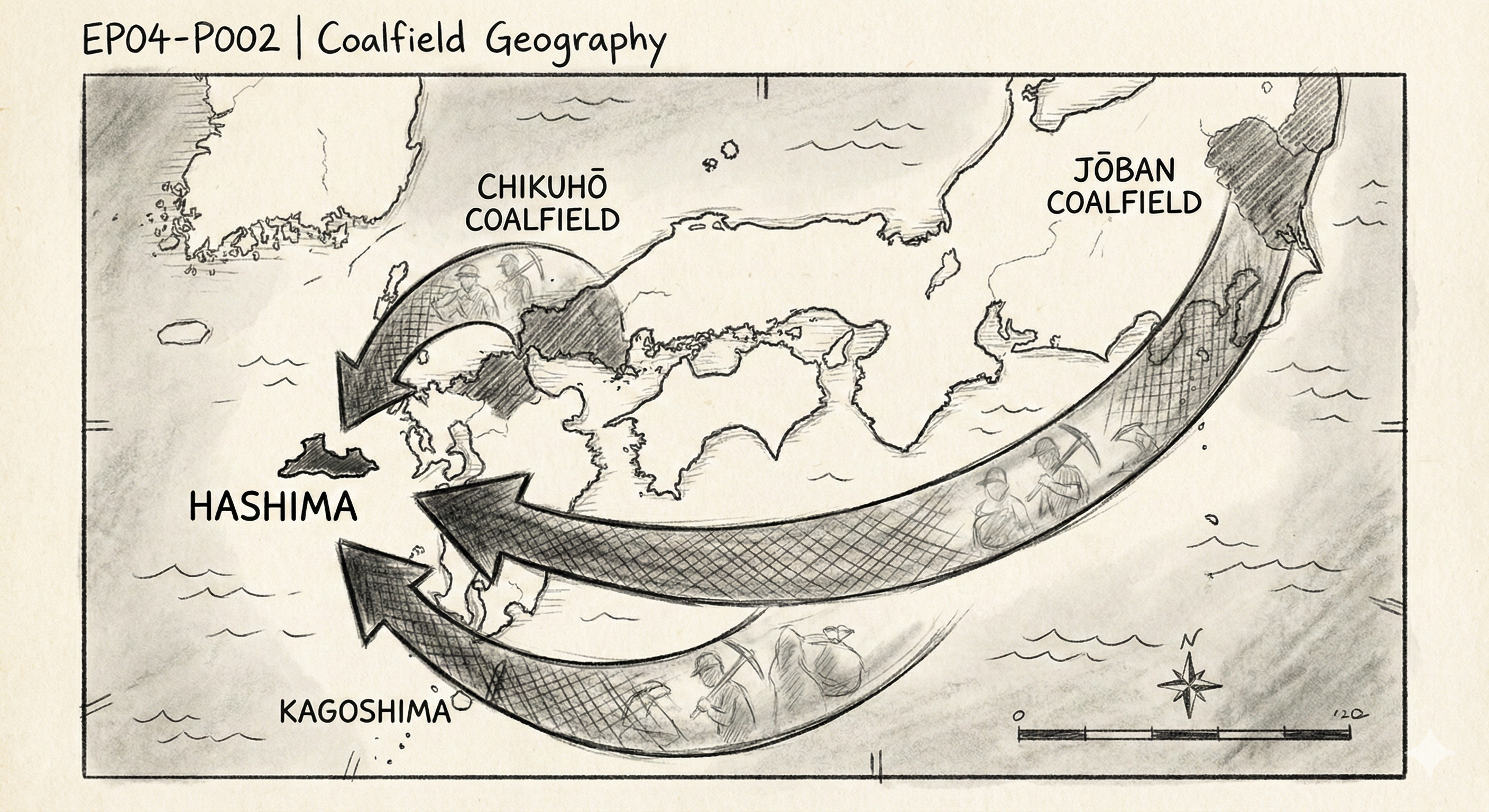 EP04-P002 — Japan's coalfield geography and migration routes
The Recording Moment: 1961
In 1961, Japanese ethnomusicologist Ryutaro Hattori compiled Traditional Folk Songs of Japan for Smithsonian Folkways. The album was an act of salvage ethnography — an attempt to document regional traditions that were disappearing as Japan industrialised and urbanised.
The timing matters. In 1961:
5,259 people on 6.3 hectares — the highest population density anywhere on Earth. The island community was at its fullest extent.
Hattori's compilation captures regional folk traditions at the very moment Hashima was most populated — and the coal industry was about to decline.
Japan announces the transition from coal to petroleum. The coalfields that had supplied Hashima's workforce begin their terminal decline.
The mine closes in April. Within weeks, residents evacuate. The songs, if any remained, leave with them — undocumented.
The songs Hattori recorded weren't living labour traditions captured in the coalfields themselves. They were performances — staged, recorded, and preserved at the precise moment those traditions were becoming heritage rather than practice. Yet they represent the source cultures from which Hashima's population was drawn.
Pause and Consider
What does it mean to document a "traditional" song in 1961 — three decades after the gramophone and commercial recordings had already transformed how folk songs circulated?
By the time Hattori recorded these performances, versions of songs like Tankō Bushi had been selling on Victor Records since 1932. Were the singers performing "authentic" regional traditions, or echoes of commercial recordings that had already standardised what "folk" sounded like?
The Source Regions
Four songs from Hattori's album are licensed for use in this project. Each represents a region from which Hashima's workers were drawn — and each offers a window into the cultural world they left behind.
Coal Miner's Songs of Jōban
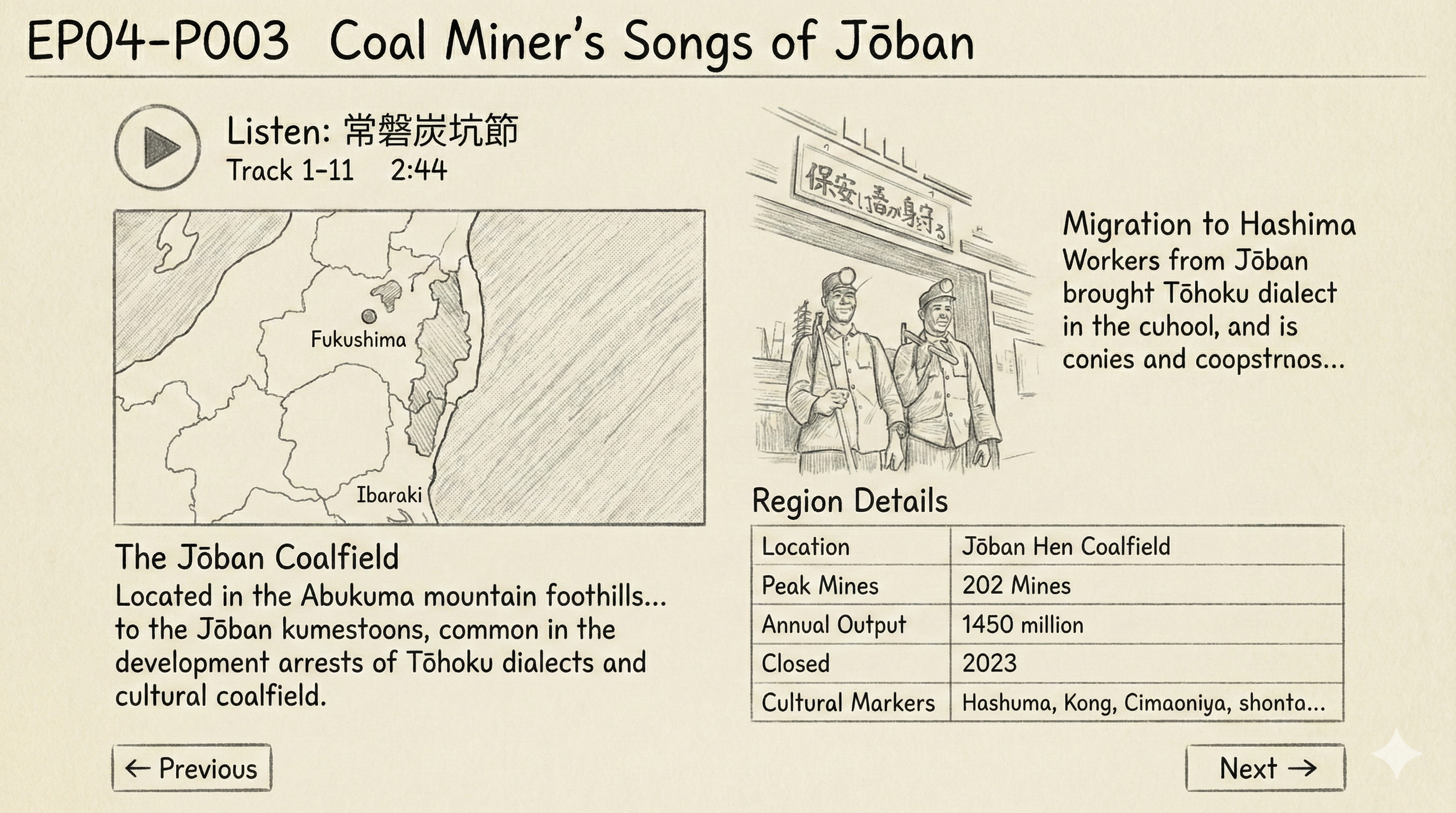 EP04-P003 — Jōban coalfield, northeastern Japan
From Traditional Folk Songs of Japan (Folkways FW04534, 1961). Licensed for educational use.
The Jōban Coalfield
Located in the Abukuma mountain foothills of Fukushima and Ibaraki prefectures, the Jōban coalfield was Japan's largest mine by 1944. At its peak in the 1950s, over 130 mines operated across the region, producing 4.3 million tons of coal annually. The coalfield closed in 1976 — just two years after Hashima. The site later became the location of the Fukushima Daiichi nuclear power plant.
Migration to Hashima
Workers from Jōban brought Tōhoku dialect and northeastern cultural traditions to the island. As the Jōban coalfield declined through the 1960s, Hashima's higher wages would have drawn workers southward — a migration from one dying industry to another's final years.
The Coal Miner's Song in Kyushu
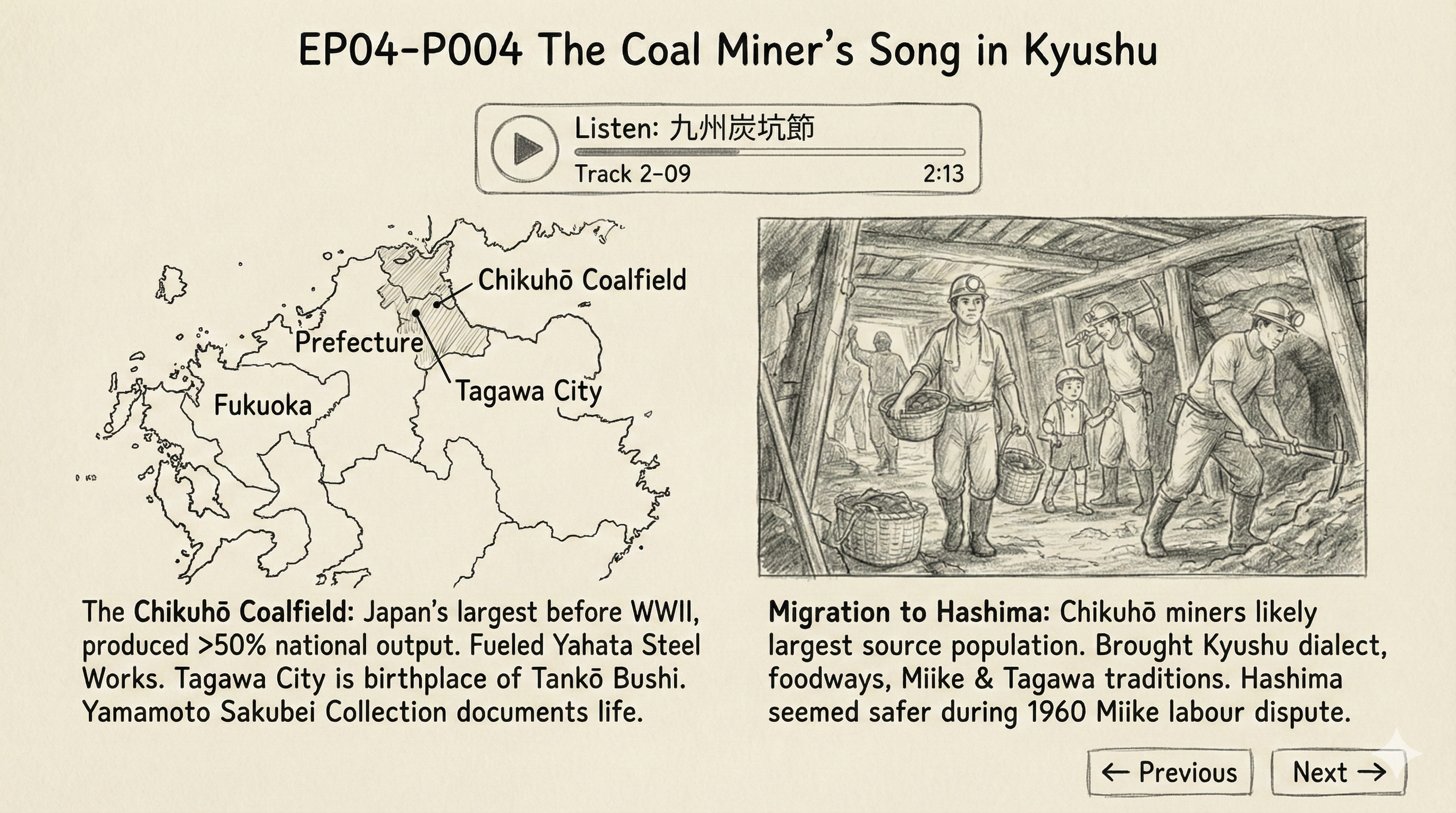 EP04-P004 — Chikuhō coalfield, birthplace of Tankō Bushi
From Traditional Folk Songs of Japan (Folkways FW04534, 1961). Licensed for educational use.
The Chikuhō Coalfield
Japan's largest coalfield before World War II, Chikuhō produced over 50% of national coal output. Spanning 787 square kilometres across Fukuoka Prefecture, the coalfield fueled the Yahata Steel Works and Japan's industrialisation. Tagawa City, within the Chikuhō region, is the birthplace of Tankō Bushi — Japan's most famous coal mining song. The Yamamoto Sakubei Collection, a UNESCO Memory of the World, documents life in these mines through paintings and writings by a miner who began working at age seven.
Migration to Hashima
Chikuhō miners likely formed the largest single source population for Hashima. They brought Kyushu dialect, regional foodways, and direct experience of the Miike and Tagawa mining traditions. When the 1960 Miike labour dispute convulsed the coal industry, Hashima — operated by Mitsubishi rather than Mitsui — may have seemed a safer option for workers seeking stability.
Kagoshima Ohara Bushi
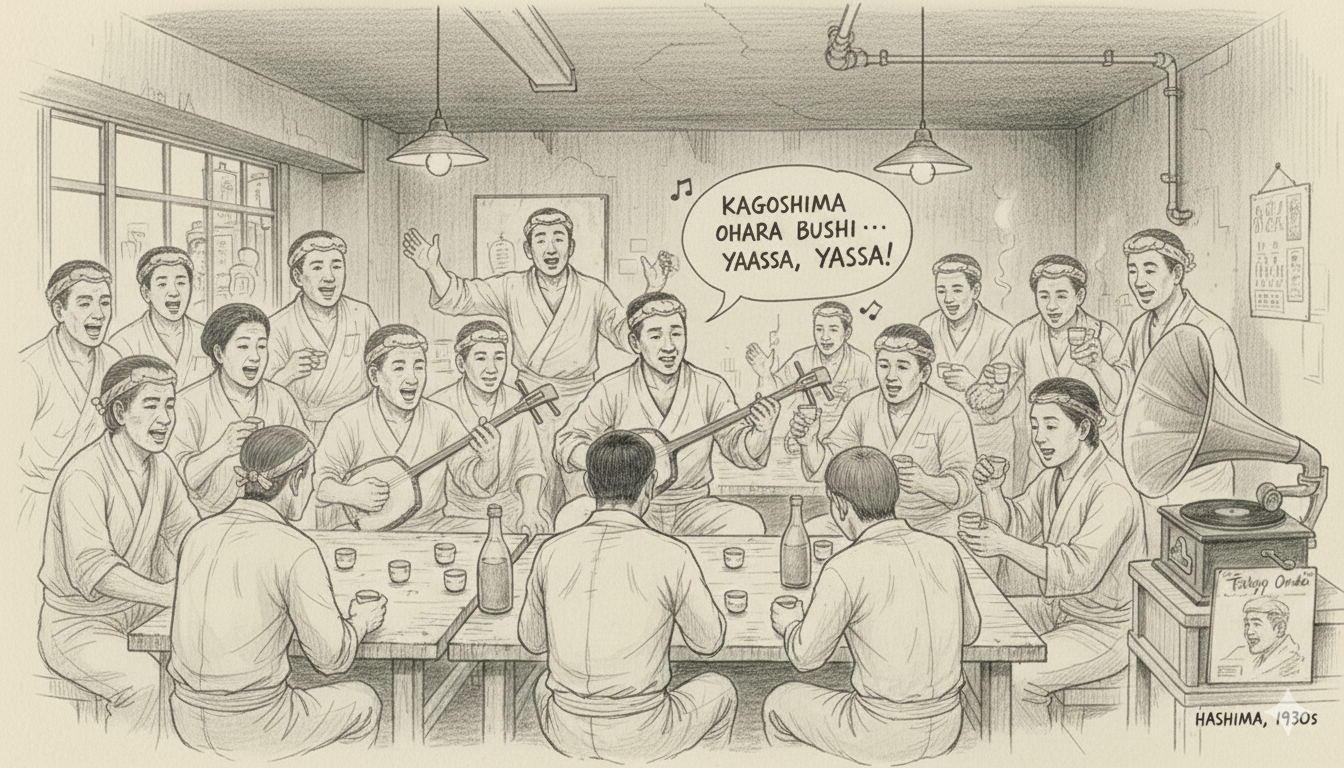 EP04-P005 — Kagoshima, Satsuma warrior song traditions
From Traditional Folk Songs of Japan (Folkways FW04534, 1961). Licensed for educational use.
The Ohara Bushi Tradition
Unlike the other songs here, Ohara Bushi originated not in the coalfields but in Satsuma warrior culture. Beginning as Yassa Bushi — a samurai battlefield song — it transformed over centuries into a labour song for soil-compacting work in construction. Geisha popularised it in the Taishō Era (1912–26), and it became a nationwide Bon dance song. Most significantly, composer Nakayama Shinpei borrowed its melody for Tokyo Ondo in 1932 — linking Satsuma tradition to Tokyo's most famous festival song.
Migration to Hashima
Workers from Kagoshima brought Satsuma dialect — notably different from other Kyushu varieties — and sweet potato shōchū culture. Kagoshima has a long history of labour migration stretching back to the Meiji era. On Hashima, Kagoshima workers would have encountered not only the Chikuhō miners but also the echoes of their own regional song in the Tokyo Ondo that played at festivals across Japan.
The Song of Bathing in the Hot Spring
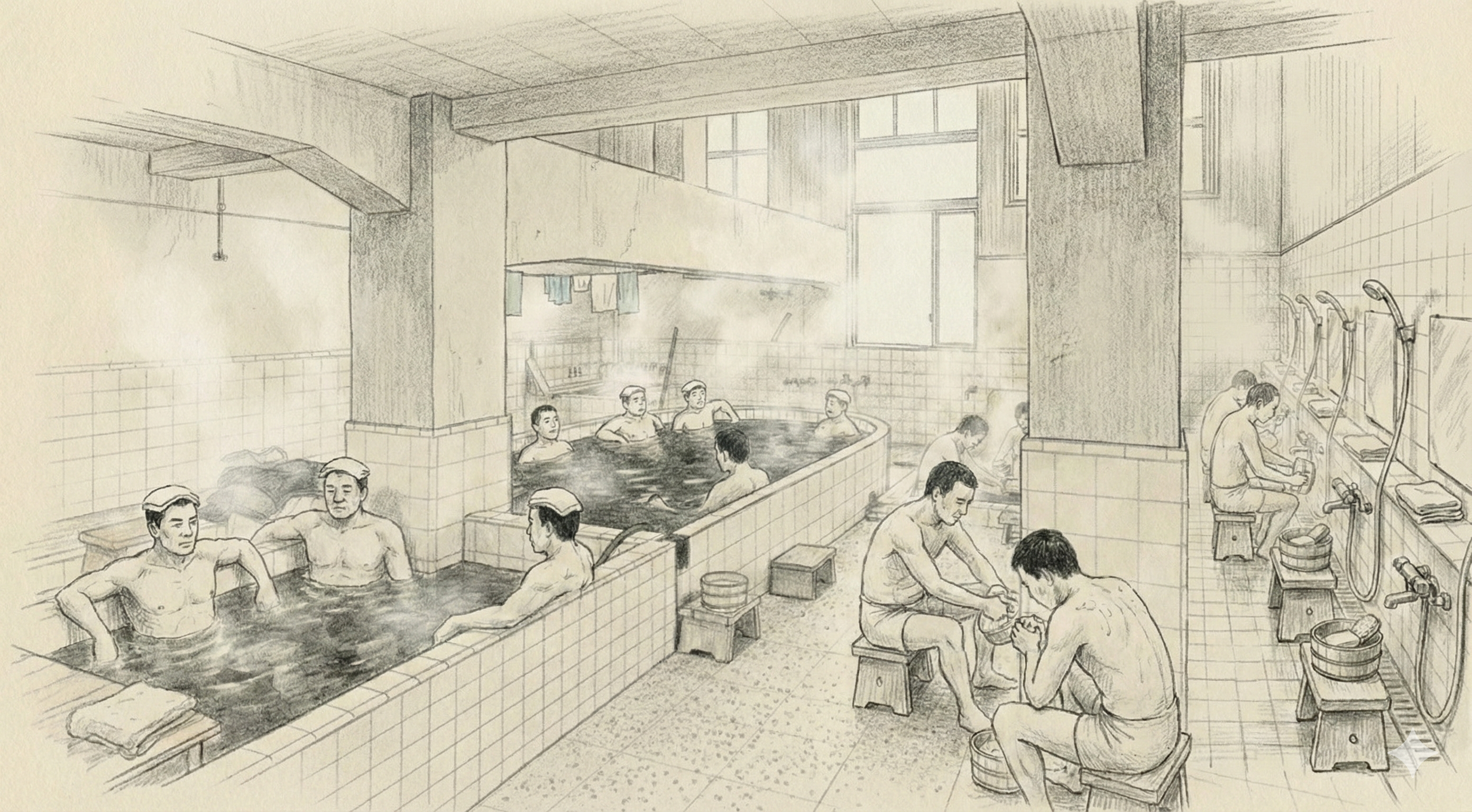 EP04-P006 — The sentō, communal bathing and social connection
From Traditional Folk Songs of Japan (Folkways FW04534, 1961). Licensed for educational use.
Iwai Onsen
Iwai is a historic hot spring town in Tottori Prefecture, on Japan's San'in coast. While not a coalfield, the song's inclusion reflects the importance of communal bathing in Japanese working-class culture — the sentō as a space of bodily recovery and social connection after gruelling labour.
Relevance to Hashima
Hashima had communal bathhouses — essential infrastructure for a mining community. The daily rhythm of shift work followed by bathing was universal across Japan's industrial communities. The sentō would have been one of the few spaces where workers from different regions — Kyushu, Tōhoku, San'in — encountered each other outside the hierarchies of the mine and the company housing blocks.
Compare and Consider
These four songs come from very different places: northeastern Japan (Jōban), southern Kyushu (Kagoshima and Chikuhō), and the Sea of Japan coast (Iwai). Listen to each. What do you notice about dialect, rhythm, instrumentation?
Now imagine these traditions converging on a single island of 6.3 hectares. What might happen when workers from such different regions live in close quarters? Do traditions blend, compete, or disappear?
From Coalfield to Gramophone
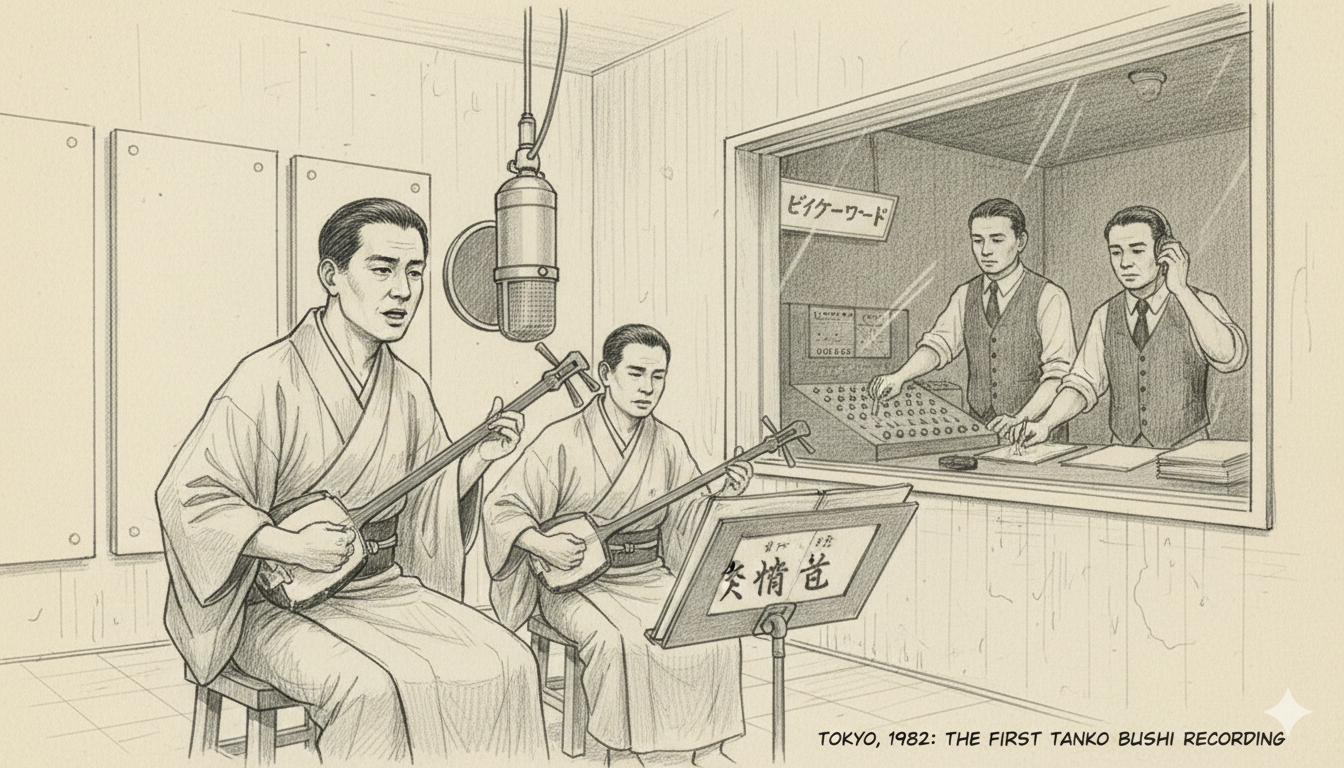 EP04-P007 — From coalfield tradition to Victor Records
Before we can understand what the miners brought to Hashima, we must understand what had already happened to their songs.
The story of Tankō Bushi — Japan's most famous coal mining song — illustrates how recording technology transformed folk tradition into mass culture.
1932: The Recording Moment
In 1932, Victor Records Japan released the first commercial recording of Tankō Bushi (Victor V-41543). The singer was Suzuki Masao (1900–1961), a professional min'yō (folk song) performer from Miyagi Prefecture — not from the Kyushu coalfields where the song originated.
That same year, composer Nakayama Shinpei wrote Marunouchi Ondo for a business-sponsored Bon festival in Tokyo's Hibiya Park. The commission came from a tea shop owner who wanted to boost local commerce — a purely secular affair designed to promote business, not honour the dead. Nakayama borrowed the melody from Kagoshima Ohara Bushi. The following year, with revised lyrics, it became Tokyo Ondo — an explosive nationwide hit.
Both recordings were products of the recording industry's commercial logic:
- Standardisation: Regional variants flattened into single "definitive" versions
- Professionalisation: Songs performed by trained studio artists, not coalfield workers
- Commodification: Tradition packaged for urban consumers nostalgic for a rural past
- Dissemination: Gramophones and radio carrying these versions across Japan
Modern arrangements of Tankō Bushi replace the original lyric "Miike Tankō" (Miike Coal Mine) with "uchi no oyama" — a generic term meaning "our coal mine." The specific place name was erased; the song became universally applicable, divorced from the actual workers who first sang it.
Evaluate the Evidence
By the time workers arrived at Hashima in the 1950s–60s, commercial recordings of coal mining songs had been circulating for three decades. Radio was ubiquitous. Television was spreading.
When these workers sang — if they sang — were they performing the regional variants their parents knew, or the Victor Records versions they'd heard on the radio? How would we know the difference? What evidence could help us answer this question?
Continue the Story
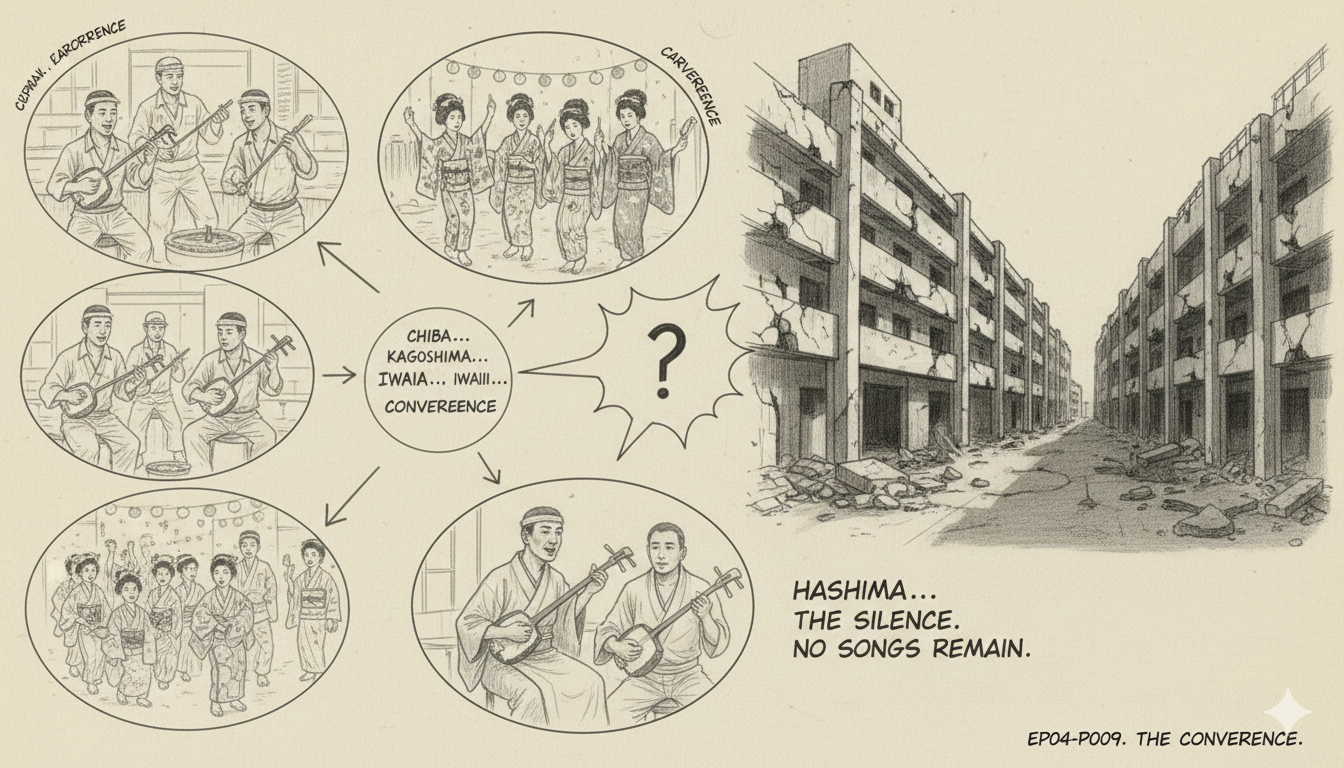 EP04-P009 — Convergence: what happened when traditions met
These songs represent the source cultures — what the workers brought with them when they arrived at Hashima. But what happened when miners from Fukuoka, Fukushima, Kagoshima, and elsewhere converged on a single 6.3-hectare island? Why are there no documented folk songs from Hashima itself?
A companion experience exploring what happened to these traditions inside Mitsubishi's controlled environment is currently under construction.
Listening as Historical Practice
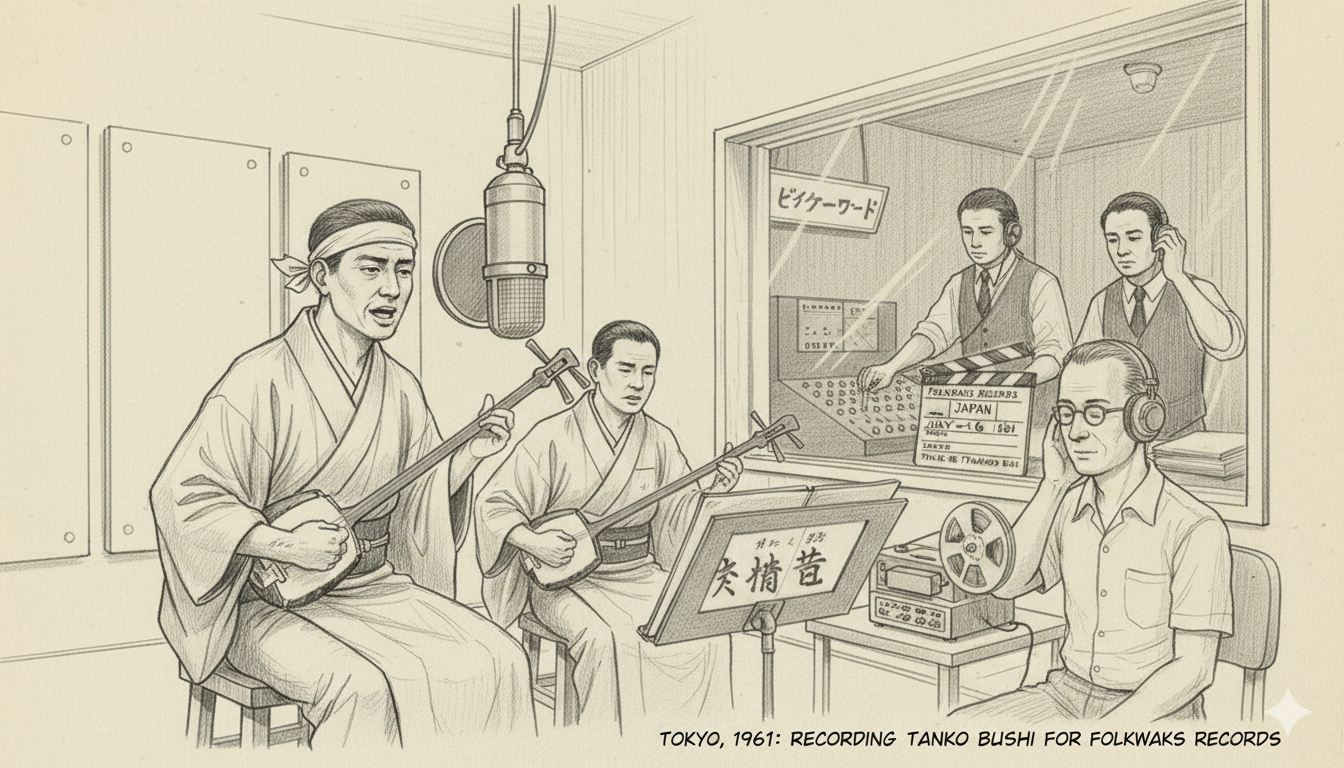 EP04-P008 — Sound as historical evidence
The songs in this module are not simply entertainment. They are evidence — a form of historical documentation that official records rarely capture.
When you listen to a coal mining song, you encounter:
- Dialect: Regional language that encodes place and identity
- Labour rhythm: Songs often matched the tempo of work — coordinating movement, marking time
- Social function: Who sang? When? For what purpose? The performance context shapes meaning
- Affect: The emotional texture of community life — solidarity, complaint, celebration, grief
None of this appears in company records, government statistics, or architectural surveys. Sound offers access to dimensions of historical experience that document-based history cannot reach.
But sound evidence has its own limitations. The 1961 Folkways recordings are performances staged for a microphone — not spontaneous expressions of community life. The singers knew they were being recorded for an international audience. The songs were selected by an ethnomusicologist with his own preservation agenda. What we hear is mediated, curated, framed.
This is true of all historical evidence. Documents, photographs, oral histories — each offers a partial view, shaped by who created it, for what purpose, under what conditions. The task is not to find unmediated access to the past, but to read sources critically, aware of what they can and cannot reveal.
Discussion Questions
- Evidence and absence: How does the absence of documented folk songs from Hashima change how we understand the island's history? What other kinds of "absent evidence" might shape historical knowledge?
- Commodification of tradition: The 1932 Victor recording of Tankō Bushi was performed by a professional singer from a different region. What is lost and what is gained when folk traditions become commercial products?
- Heritage and intangibility: UNESCO's World Heritage inscription for Hashima focuses on industrial structures. How might the site's interpretation change if intangible heritage — songs, festivals, daily practices — were given equal weight?
- Convergence and community: Workers from across Japan converged on Hashima's 6.3 hectares. What happens to regional identity in such compressed, artificial communities?
- Listening as method: This module asks you to listen to songs as historical evidence. What can you learn from sound that you cannot learn from documents? What are the limitations of sound as evidence?
Key Takeaways
- Hashima's workers came from across Japan's coalfield regions. They brought regional traditions — including the songs documented in the 1961 Folkways album — to an artificial island community.
- Recording technology transformed folk tradition before it reached Hashima. By the 1950s, commercial recordings had already standardised and commodified songs like Tankō Bushi.
- The company town structure controlled daily life. Housing, provisioning, and entertainment were company-managed. What space remained for vernacular tradition is unclear.
- No documented folk songs exist from Hashima itself. This absence may reflect absence of practice, absence of documentation, or both. The silence is itself evidence.
- Sound offers evidence that documents cannot. Dialect, rhythm, affect, and social function are captured in song. But all evidence requires critical reading.
- Heritage regimes shape what survives. UNESCO's inscription focuses on industrial structures, not intangible heritage. What is preserved determines what can be remembered.
Audio Source & Licensing
The songs in this module are from Traditional Folk Songs of Japan (Folkways Records FW04534, 1961), compiled by Ryutaro Hattori with translations by Iwao Matsuhara.
Four tracks are licensed for educational use in this project under Smithsonian Folkways License #7331 (1 April 2024 – 1 April 2029).
For the complete album including liner notes, visit: Smithsonian Folkways